-

Silicon Valley’s Early Advantages
Norm Pond talks about the advantages that the Valley of the Heart’s Delight had over other regions and how this laid the foundation for the growth of the electronic’s industry.
-

Start of Semiconductor Era in Silicon Valley
Paul Wesling provides a brief overview of the transition from tubes to semiconductors in the 1950s.
-

Ted Hoff Looks at Silicon Valley in the 60s
Ted Hoff gives his perspective on Silicon Valley in the late 1950s and 1960s. He talks about some of the technologies he worked on and saw at Stanford, including analog memory, pattern recognition, microwave radio technology and lasers. He points out that Stanford’s ties with industry allowed the exchange of ideas that helped Silicon Valley…
-

Ted Hoff Commenting on Moore’s Law
Ted Hoff explains the economics of Moore’s law and how it was a useful tool for predicting the cost of an integrated circuit. He also talks about Intel’s 1102 and 1103 chips, as well as Intel’s first building.
-
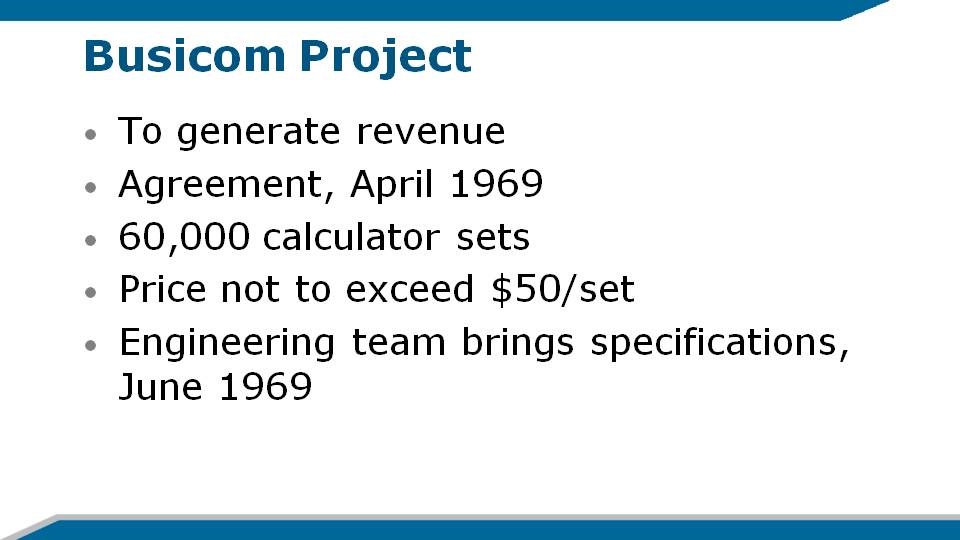
Busicom Impact on Intel
Ted Hoff talks about the importance of Intel’s contract with Busicom in the late 1960s to produce chips for a calculator and how that effort became the basis for their first microprocessor.
-
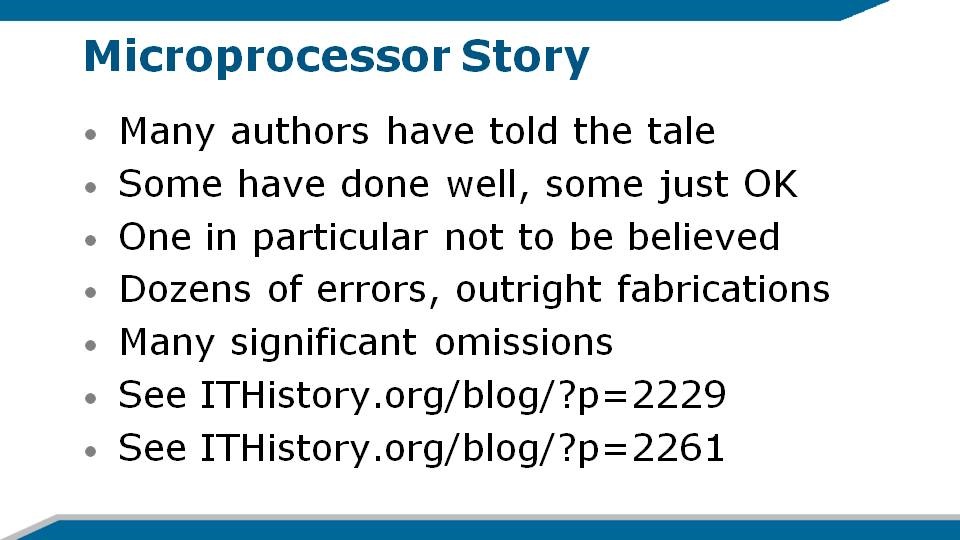
The Development of the Intel 4004 Microprocessor
Ted Hoff talks about the development of the Intel 4004 microprocessor. As the architect of this first microprocessor, Hoff brings unique insight into its role in shaping Intel into the semiconductor juggernaut that it became.
